Introduction
Selecting UVC LEDs for HVAC air disinfection requires more than choosing a high-output LED, because the treatment target and operating conditions determine how much germicidal performance the system actually needs. HVAC manufacturers, air purification OEMs, and automotive HVAC developers may use UVC LEDs in airflow paths, around evaporator coils, or within other internal treatment zones, so the selection criteria vary with the equipment structure. A practical selection process should therefore consider the treatment location, wavelength and radiant output, airflow and dose, optical coverage, operating requirements, integration level, and final performance validation.

Define the HVAC Treatment Location
The first selection step is to identify the intended treatment location because air treatment and
internal surface treatment require different irradiation arrangements.
Airflow Path Treatment
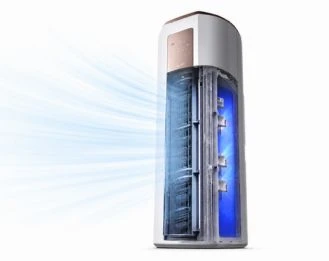
For UVC LED HVAC applications, UVC modules can be positioned within return-air paths or other airflow-channel locations to treat circulating air as it passes through the irradiation zone.
Coil & Heat Exchanger Treatment
For evaporator coils, heat exchangers, and other internal surfaces, the UVC LED should be directed toward the target surface to support surface microbial control, while some HVAC designs can combine surface irradiation with circulating-air treatment.
Match Wavelength & Radiant Output to the Application
Wavelength and radiant output should be selected according to the intended germicidal application and required performance rather than by choosing the highest available UVC LED output.
For many UVC LED air disinfection applications, 270–280 nm provides a practical reference range for compact air-treatment modules, while radiant output needs to be matched to the treatment target and overall system design. An air-conditioning UVC module, for example, is specified with 270–280 nm UVC LEDs and 15–30 mW radiant flux, illustrating how wavelength and optical output can be defined as part of an application-specific configuration.
For UVC LED air sterilization, OEM engineers should therefore evaluate wavelength and radiant output together with the intended microbial-reduction target instead of treating either specification as a standalone indicator of system performance.

Account for Airflow, Exposure Time & UVC Dose
Airflow determines how long microorganisms remain within the irradiation zone, so the required UVC performance must be evaluated against the actual air movement through the system.
A useful engineering relationship is UVC Dose ≈ Irradiance × Exposure Time, meaning that changes in airflow velocity directly affect the exposure time available for UVC treatment.
When airflow increases, the system may need to compensate through its overall irradiation conditions to maintain the required dose, while lower airflow can provide longer exposure under otherwise similar conditions.
For an UVC LED HVAC disinfection system, dose should therefore be established from the actual airflow rate and treatment conditions rather than inferred from the LED's rated radiant output alone.
Evaluate Optical Coverage & Installation Space
Once the required UVC performance is established, engineers need to determine whether the selected LED configuration can deliver that irradiation effectively within the available HVAC space.

Airflow Channel Coverage
For an UVC LED for HVAC systems, LED placement, irradiation direction, treatment distance, and optical layout should be configured so that the intended airflow or treatment zone receives sufficient and appropriately distributed UVC irradiation.
Compact HVAC & Air Purification Integration
For an UVC LED for air purification, the optical assembly should fit within the available internal space while maintaining the intended irradiation coverage without creating an impractical mechanical arrangement.
Check Thermal, Electrical & Environmental Requirements
The selected UVC LED must meet the HVAC equipment's operating requirements so that the intended optical performance can be maintained throughout normal operation.
Engineers should evaluate drive voltage and current, power consumption, heat dissipation, junction temperature, mounting conditions, and electrical connections according to the equipment architecture.
HVAC applications may also expose the UVC assembly to temperature changes, humidity, condensation, vibration, and repeated switching, making these environmental conditions important requirements during component and module selection.

Select the Right Level of UVC LED Integration
OEMs should determine whether their project requires a bare UVC LED, an LED array, or a complete UVC module based on how much of the optical, electrical, and mechanical integration needs to be handled at the component level.
A bare LED can suit projects where the OEM already controls the PCB, optics, driver, thermal structure, and mechanical design, while an integrated UVC module can simplify development when these elements need to be configured together for a specific HVAC platform.
For automotive HVAC and compact air-treatment equipment, module-level integration can be particularly useful when the UVC source needs to be incorporated into an existing product architecture without developing every supporting component independently.

Validate UVC Performance Under Actual HVAC Conditions
Before finalizing an UVC LED air disinfection system, engineers should confirm that the selected configuration delivers the required dose and microbial reduction under operating conditions representative of the finished HVAC equipment.
Optical simulation and thermal analysis can help evaluate the proposed design before prototyping, while irradiance measurement, UVC dose assessment, quantitative germicidal testing, and reliability testing can verify whether the final system meets its intended performance. UVLEDTEK supports application-specific UVC wavelength and dose engineering, optical and thermal simulation, prototyping, and quantitative germicidal testing for air-treatment applications.
A capable supplier should be able to support HVAC OEMs from application assessment and UVC configuration through prototype development and performance validation. This capability allows engineers to verify the selected solution against the actual airflow, treatment target, and operating conditions before moving toward production.


Conclusion
Choosing the right UVC LEDs for HVAC air disinfection requires matching the UVC source to the treatment location, required dose, optical coverage, equipment operating conditions, and appropriate integration level. A successful selection should be confirmed through application-specific testing rather than relying only on wavelength or LED radiant output listed on a component specification sheet. Contact our engineering team to discuss your HVAC airflow, treatment target, installation requirements, and UVC performance needs for a solution tailored to your application.