Delivering Safe Water to Municipal, Industrial, Residential, and Commercial Facilities
UVC LED, as a revolutionary water disinfection technology, is becoming a key solution for green water treatment due to its core advantages of pure physical action, instant microbial inactivation, and zero chemical addition. It effectively prevents the secondary pollution and by-product risks associated with chemical disinfection, and can degrade chlorinated organic compounds, eliminating the hazards of combined chlorine. The operation is safe, with no risks associated with chemical transportation and preparation, making it a veritable new green and environmentally friendly technology.
The Advantages for UVC LED Technology
- Inherently Safe & Eco-Friendly: Adopts solid-state technology with no mercury or chemicals, eliminating toxicity risks and disinfection by-products (DBPs) at the source.
- Preserves Water Purity: A purely physical process that leaves no trace-water's color, taste, pH, and other properties remain completely unchanged.
- Compact, Efficient & Reliable: Outperforms traditional mercury lamps with compact footprint, reduced energy consumption, extended service life, and hassle-free integration and installation.
- Comprehensive Microbial Inactivation: Delivers broad-spectrum efficacy, reliably eliminating chlorine-resistant pathogens like Cryptosporidium and Giardia (the "two pests") for assured biological safety.
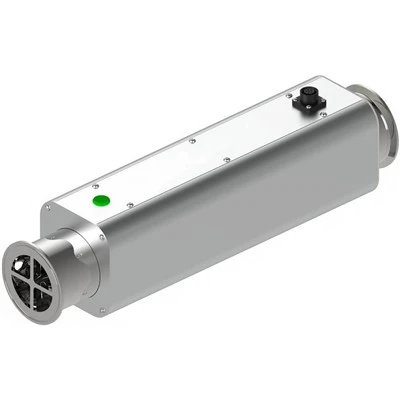
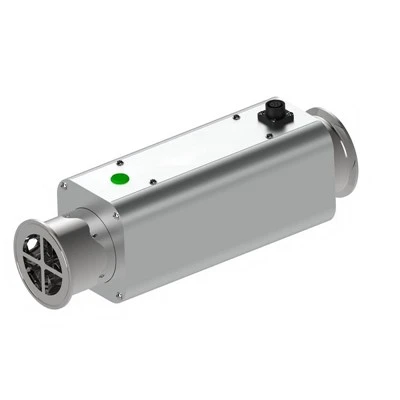
The Advantages for UVLEDTEK's High Flow Sterilizer

Shadow-Free UV Illumination Design Ensures Complete Sterilization Coverage
Utilizing advanced geometrical optics design and incorporating multi-medium penetration simulation alongside multi-physical field numerical modeling, UV light is precisely and fully directed into the reaction chamber. This creates a highly efficient UV radiation zone within the chamber that is entirely free of shadows. This innovative design guarantees that every part of the water flow receives sufficient ultraviolet exposure during the disinfection process, achieving comprehensive, 360-degree sterilization and effectively eliminating any blind spots caused by uneven light distribution.
Flow Field Design with Rotational Flow-Guiding Device: Optimizing Flow Pattern and Enhancing Efficacy
Through in-depth research into hydrodynamic behavior, our R&D team identified that the maximum flow velocity significantly impacts disinfection efficacy. From a fluid dynamics perspective, water flowing at excessively high speeds may pass through the ultraviolet irradiation zone too quickly, reducing the exposure time microorganisms receive and thus compromising sterilization effectiveness. By ingeniously modifying the configuration of the inlet and outlet, our team successfully guides the water to rotate as it passes through the irradiation zone, effectively reducing the peak flow velocity.
This design improves sterilization performance and ensures a more uniform distribution of absorbed UV dose throughout the water volume. The rotational flow pattern ensures that microorganisms are fully exposed to UV light, guaranteeing that each receives a sufficient germicidal dose, thereby significantly enhancing the overall sterilization efficiency.


User-friendly Interface for Straightforward Operation
This sterilizer for secondary water supply features a user-friendly Human-Machine Interface (HMI). Through this clear and intuitive interface, operators can easily monitor key real-time operational parameters such as UV dose, light intensity, and flow rate. It also provides convenient access to device logs and alarm histories via a simple menu. This straightforward and logical design significantly reduces the learning curve for personnel, enhances operational and maintenance efficiency, and ensures convenient and effective device management.
In-Pipe Water Cooling Technology for High-Efficiency Heat Dissipation
The system adopts an advanced water-cooling method, which directly utilizes the water within the pipeline to dissipate heat from the light source. This eliminates the need for additional dedicated cooling equipment, significantly reducing investment costs. Furthermore, this technology is characterized by its compact size and high efficiency. Through an AI control algorithm, it can dynamically adjust light intensity and cooling water flow in real-time based on changes in treatment volume, achieving energy savings and reduced consumption. Additionally, the quartz optical window maintains a temperature consistent with the water, effectively mitigating scaling issues. Maintenance is convenient, allowing for the disassembly and servicing of the light source without the need to stop water flow or switch pipelines. Monitoring of actual operational equipment has revealed that employing this cooling technology can extend the service life of the light source by 30%-50%.


RED-CFD Coupled Simulation Enables Precise Quantification and Reliable Operation
The system adopts the internationally leading RED-CFD design for UVC LED reactors. In this design, the light sources are directly immersed in the water without protective sleeves, which results in a more rational flow pattern and facilitates the coupling of the light field with the flow field. A high-reflectivity design further enhances UV light efficiency. The direct current (DC) power supply eliminates the need for high-frequency ballasts and can be directly connected to photovoltaic power sources, enabling efficient energy utilization. Additionally, this design features lower head loss, a more compact overall unit size, and reduced installation space requirements. Through RED-CFD coupled simulation analysis, core parameters such as the device's UV disinfection dose, light source configuration, water flow velocity, and UV transmittance (UVT) can be precisely quantified. This ensures outstanding product performance and reliable operation, providing users with a stable and highly efficient disinfection solution.
Modular Design Simplifies Maintenance, Saves Energy, and Reduces Costs
The system employs a modular design concept, where the light source modules and the reaction chamber are independent units. UV light is uniformly introduced into the water body through high-transmission quartz glass on the reaction chamber. This allows for the rapid replacement of any faulty module without interrupting the water supply, ensuring the continuous and stable operation of the equipment. The UVC LED sterilizer starts up instantly, reaching peak power immediately with no warm-up time required (traditional mercury lamps require 15-30 minutes for warm-up, with a slow rise in light intensity). Frequent start-stop operations do not damage the device's lifespan (the lifespan of traditional mercury lamps degrades rapidly with frequent cycling). Furthermore, the system can be integrated with flow rate, residual chlorine, and UVT sensors for coordinated adjustment, allowing for precise adaptation to varying operational conditions.