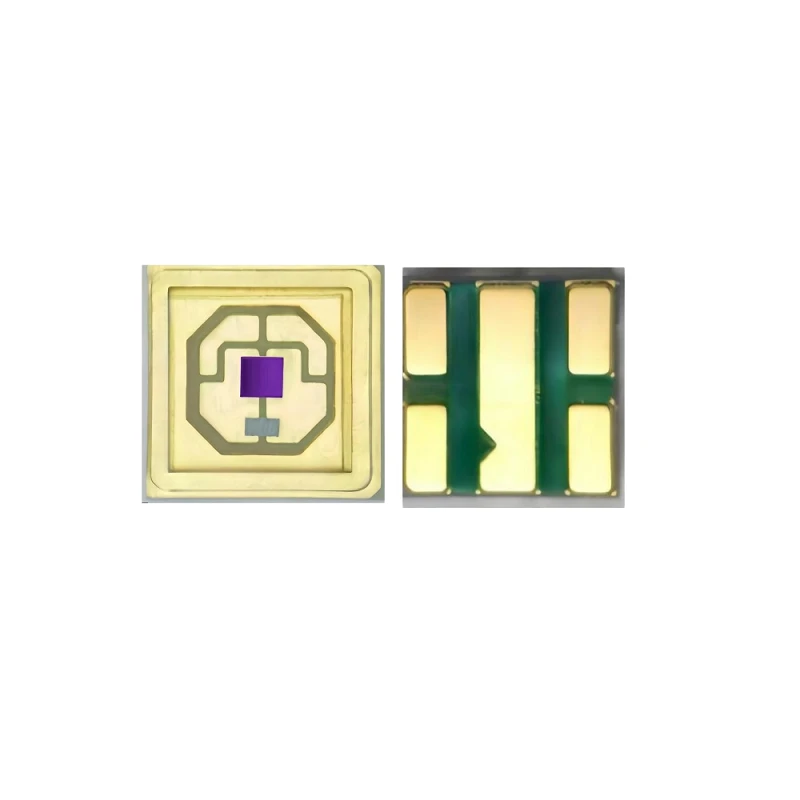
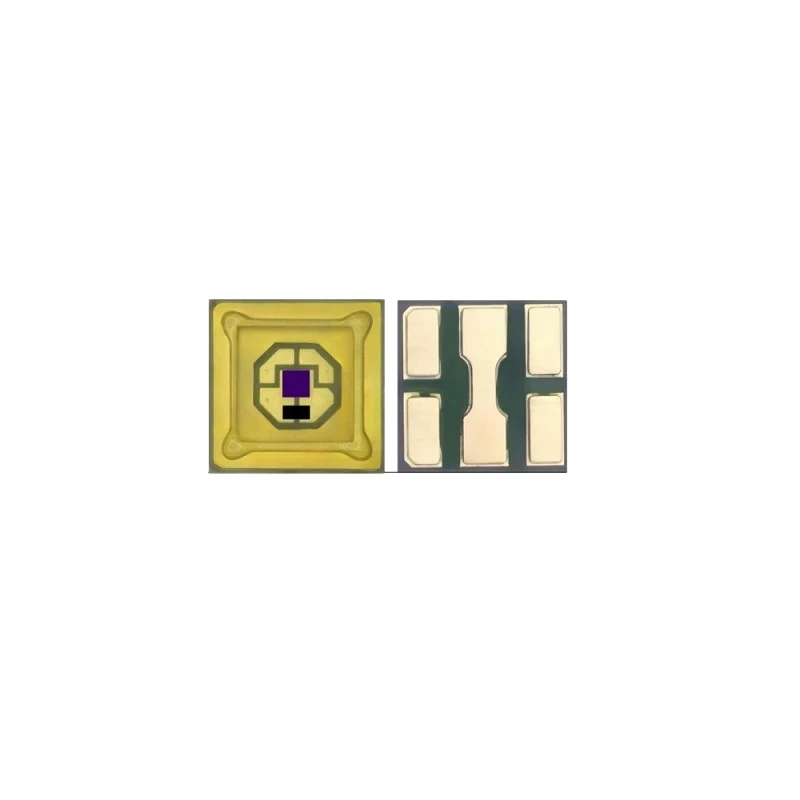
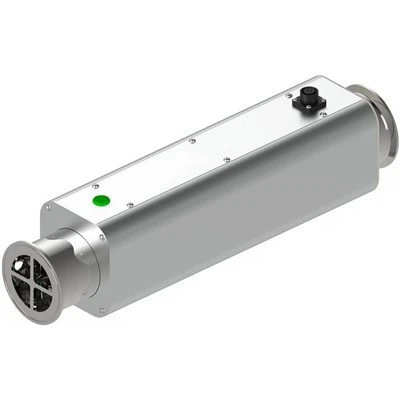
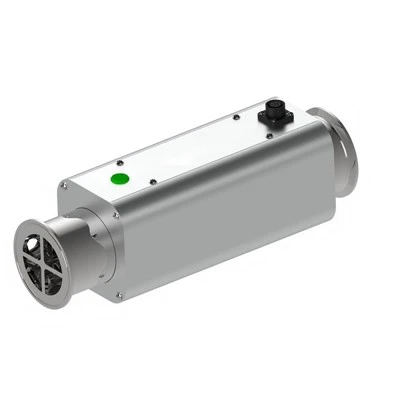
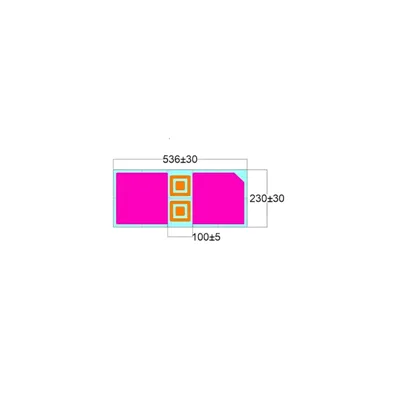
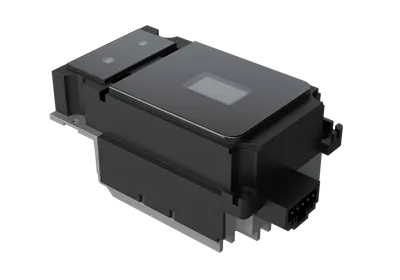
Amid growing public concern over drinking water safety, Quanzhou Huajing Innovation Technology Co., Ltd., leveraging the advanced chip technology of its controlling parent company UVLEDTEK, has developed a cutting-edge UVC LED ultraviolet disinfection system to strengthen the safety of potable water.
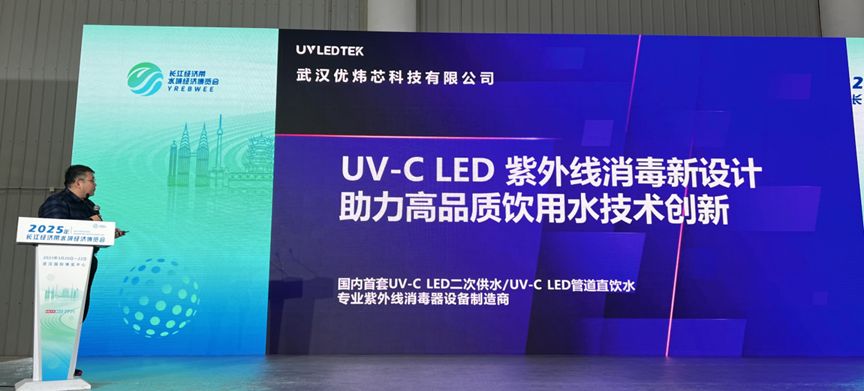
At the recently concluded Yangtze River Economic Belt Water Expo, Gao Chao, R&D Director of the Water Treatment and Testing Research Division of the company's Central Research Institute, was invited to deliver a presentation titled "New Design of UVC LED Ultraviolet Disinfection: Enabling Technological Innovation in High-Quality Drinking Water."
The report provided an in-depth overview of the innovative applications and broad prospects of UVC LED technology in point-of-use water treatment. It sparked extensive discussion among experts, scholars, and industry professionals. The latest research findings and practical application cases demonstrated at the event offered attendees a clear view of how innovative technologies are transforming drinking water safety.
UV LED Driver Technology
Powering Advancement Across Multiple Critical Sectors
UVLEDTEK UV LED light sources play an indispensable role across multiple key industries.
In the new energy vehicle sector, UV LED technology helps lithium batteries overcome temperature resistance challenges. In 5G communications and optical fiber manufacturing, it improves fiber drawing speed while reducing energy consumption and production costs. In public health and safety, it enables precise and efficient sterilization of bacteria and viruses. In aerospace and defense industries, it is applied in space stations and satellites, demonstrating significant strategic value.

Overcoming Key Technical Challenges
Building Full Industrial-Chain Advantages in Third-Generation Semiconductors
The growth process of core UV LED materials, AlN/AlGaN, demands extremely stringent precision in process parameters. Even minor deviations can alter the crystal structure of the material, significantly affecting its optoelectronic performance.
Through a decade of dedicated R&D, UVLEDTEK has established full industrial-chain capabilities in research, development, and manufacturing. The company has broken through technological restrictions and achieved independent and controllable core technologies, strengthening its position in third-generation semiconductor development.

Deepening in Water Treatment Applications
Precise Sterilization Ensuring Water Safety
UVC LED technology shows broad application potential in the water treatment sector. From water plants to every point-of-use drinking terminal, from treated wastewater discharge to post-treatment purification; from food and beverage production, livestock farming, and pharmaceutical manufacturing to sterile water systems in semiconductor processes; from household drinking water to public environments such as restaurants, beverage shops, and amusement parks; and from industrial cooling water disinfection to swimming pool sanitation-safe and effective water sterilization is required in virtually every scenario around us.
Compared with traditional chemical disinfection methods such as chlorination and ozone treatment, UVC LED offers significant advantages. As a physical disinfection method, it does not alter the properties of water and avoids secondary pollution caused by chemical residues. It produces no harmful disinfection by-products, ensuring safety for human health. It also provides rapid sterilization, capable of instantly inactivating pathogens within a specific dosage range, while degrading chlorinated organic compounds and eliminating combined chlorine hazards. In addition, it is safe to operate, with no risks associated with chemical storage, transport, or preparation.
Overall, it represents a true next-generation green and environmentally friendly water disinfection technology.

Compared with traditional mercury-based UV light sources, UV-LED technology is non-toxic and environmentally friendly, offers finer power control, has a longer service life, enables instant startup, and features a compact structure. UVC LED technology demonstrates significant advantages in energy consumption, maintenance costs, and disinfection performance, providing both higher economic efficiency and stronger sustainability benefits for water supply systems.
Internationally, the United Kingdom's TYPHON Treatment Systems has built the world's first municipal-scale UV LED drinking water disinfection system, with a treatment capacity of up to 28 MLD (5,136 GPM). The system utilizes advanced UVC LED technology, combined with precise optical field design and flow optimization, achieving a 4-log reduction value (LRV) against Cryptosporidium at 22 mJ/cm².
In addition, Norwegian water utilities have actively begun transitioning to UVC LED technology, gradually phasing out traditional mercury lamps. More pilot projects and large-scale deployments of UV LED water and wastewater treatment systems are also being implemented in countries such as the United States and across the European Union, signaling a steady global shift toward this emerging technology.

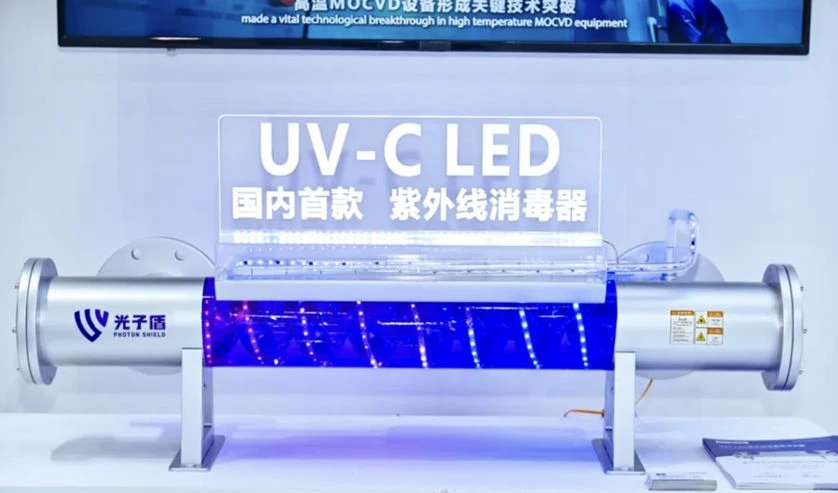
In China, Quanzhou Water Group and UVLEDTEK have partnered to advance this technology as a key R&D initiative. Together with a group of domestic experts in related fields, they have overcome major technical challenges and successfully developed China's first large-flow UVC LED disinfection system in June 2024.
The system passed all testing and validation requirements in a single round, achieving a sterilization rate of up to 99.999%. It has already been deployed in secondary water supply systems for real-world applications. At the same time, a complete product portfolio targeting secondary water supply and point-of-use drinking water applications has been fully developed, with pilot deployments currently underway across all product batches.
This progress indicates a breakthrough in overcoming foreign technological dependence. From core chip development to full-system equipment design and software integration, the entire solution is supported by independent intellectual property rights and has reached mass production capability.
This achievement significantly enhances China's capability in ensuring terminal water safety and represents an important technological innovation and substitution breakthrough in the field of drinking water disinfection systems.
Excellent Product Design
Building High Performance in All Dimensions
1. High-Optical-Power Chips and High-Power-Density Light Sources
In material growth, UVLEDTEK applies pyramid nano-patterned substrates combined with high–low speed pulsed epitaxial growth and defect-healing techniques to produce high-quality AlGaN epitaxial materials.
In chip electrode metallization optimization, a uniquely designed high-reflectivity electrode structure together with a SWDL reflective structure plays a key role, ultimately improving device luminous efficiency by more than 32%.
In addition, the R&D team carefully designs a composition-graded quantum well structure and a gradually varying composition electron blocking layer. Based on semiconductor physics principles, these innovations optimize the band structure, enhance current injection efficiency, and improve electron–hole recombination efficiency, resulting in stronger optical power output.

2. Breaking the Wavelength Limits of Traditional Mercury Lamps to Improve Efficiency
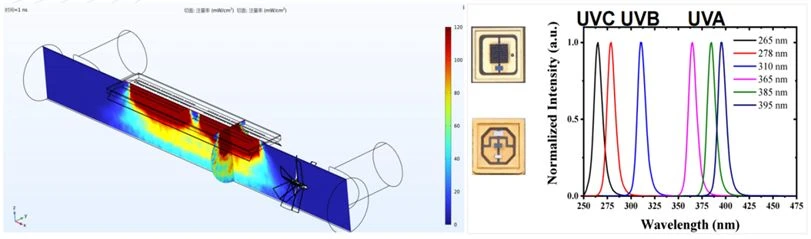
UVLEDTEK has developed AlGaN-based UV LEDs with tunable emission wavelengths ranging from 210–365 nm, breaking through the fixed 254 nm limitation of traditional mercury lamps.
International studies have shown that the 279 nm wavelength achieves better inactivation performance against MS2 compared with 254 nm. In addition, within the 260–280 nm range, UV transmission through water is superior to that at 254 nm.
For particles of the same size, such as suspended solids (SS) and microbial flocs, longer wavelengths result in weaker shielding effects. This means that under the same sterilization efficiency requirements, UVC LED systems require a lower dose, significantly improving disinfection efficiency and enabling more precise and rapid sterilization.

3. Shadow-Free Optical Field Design for Omnidirectional Sterilization
UVLEDTEK employs advanced geometrical optics design combined with multi-medium light transmission simulation and multi-physics field numerical modeling to precisely inject ultraviolet light into the reaction chamber.
Within the chamber, a high-efficiency UV radiation field without shadow regions is constructed. This innovative design ensures that during the disinfection process, every part of the water body receives sufficient UV exposure, achieving comprehensive, omnidirectional sterilization. It effectively eliminates disinfection blind spots caused by non-uniform light distribution.
4. Flow Field Design with Rotational Guidance Device
Optimizing Hydrodynamics to Enhance Disinfection Performance
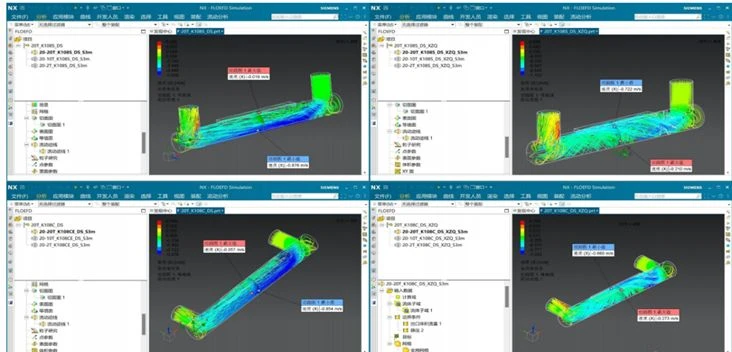
The R&D team of UVLEDTEK conducted in-depth studies on water flow behavior and found that maximum flow velocity has a significant impact on sterilization efficiency. From a fluid dynamics perspective, excessively fast water flow may shorten the residence time of microorganisms in the UV irradiation zone, preventing sufficient UV exposure and thereby reducing disinfection effectiveness.
Based on this insight, the team innovatively redesigned the inlet and outlet geometry to induce a controlled rotational flow through the irradiation zone, effectively reducing peak flow velocity.
This structural optimization not only improves sterilization performance but also ensures a more uniform UV dose distribution throughout the water body. The rotating flow enables microorganisms to be fully exposed to UV irradiation, ensuring that each pathogen receives an adequate sterilization dose, thereby significantly enhancing overall disinfection efficiency.
5. Pipeline Water-Based Light Source Cooling Technology
High-Efficiency Thermal Management
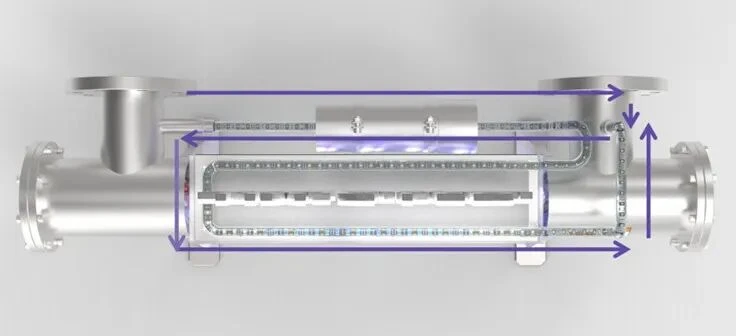
The high-power LED UV sterilizer developed by UVLEDTEK adopts an advanced water-cooling approach, directly using the water flowing within the pipeline to dissipate heat from the light source. This eliminates the need for additional dedicated cooling equipment, significantly reducing system investment costs.
The technology is compact in size and highly efficient. With the integration of an AI control algorithm, both optical output power and cooling water flow can be dynamically adjusted based on real-time treatment demand. For example, when the flow rate increases, the system automatically raises light intensity and cooling water volume to ensure stable operation; when the load decreases, both parameters are reduced accordingly to achieve energy savings.
In addition, the quartz optical window maintains thermal equilibrium with the water temperature, effectively mitigating scaling issues-unlike traditional mercury lamps, which operate at surface temperatures of 600–1000°C and are prone to fouling. Maintenance is also simplified, allowing the light source to be serviced without shutting down or diverting pipeline flow.
Operational data shows that with this cooling design, the service life of the UV light source can be extended by 30%–50%.
6. RED-CFD Coupled Simulation for Precise Quantification and Reliable Operation
The technical team of UVLEDTEK adopts an internationally advanced RED-CFD (Radiation Energy Distribution–Computational Fluid Dynamics) design for UVC LED reactors. In this configuration, the light source operates without a protective sleeve immersed in water, enabling a more rational flow field and facilitating stronger coupling between the optical field and the hydrodynamic field.
A high-reflectivity structural design further enhances UV utilization efficiency. The system uses direct current (DC) power supply, eliminating the need for high-frequency ballasts and allowing direct integration with photovoltaic energy systems for improved energy efficiency.
Compared with traditional mercury-lamp systems that rely on support structures causing higher head loss, this design significantly reduces hydraulic resistance and achieves a more compact system footprint with lower installation space requirements.
Through RED-CFD coupled simulation analysis, key parameters such as UV disinfection dose, light source configuration, and water flow velocity can be precisely quantified, ensuring superior performance and stable operation. This provides users with a highly reliable and efficient disinfection solution.

7. Simple and Intuitive Human–Machine Interface for Easy Operation
The UVC LED ultraviolet disinfection system for secondary water supply developed by UVLEDTEK is equipped with a clean and intuitive human–machine interface (HMI) design.
Through the interactive display, operators can clearly and directly monitor key operating parameters such as UV dose, light intensity, and flow rate in real time. At the same time, the interface allows easy access to system logs and alarm records via a simple menu structure.
This streamlined design significantly reduces the learning curve for operators and improves overall maintenance efficiency, making system management more convenient, efficient, and user-friendly.

8. Modular design simplifies maintenance and operation, ensuring smooth operation.
The UVC LED ultraviolet disinfection system for secondary water supply developed by UVLEDTEK adopts a modular design concept, in which the light source and the reaction chamber are structurally independent.
UV light is uniformly transmitted into the water through a high-transmittance quartz glass window on the reaction chamber, ensuring stable disinfection performance while allowing maintenance operations without interrupting water supply.
Thanks to this modular architecture, system maintenance becomes significantly more convenient. When a module fails, it can be quickly replaced without affecting the overall operation, ensuring continuous and stable system performance and providing users with a reliable operating experience.

9. Fast Response, Stable Operation, Energy Saving and Cost Reduction
The UVC LED ultraviolet disinfection system developed by UVLEDTEK features rapid start-up capability, reaching peak power output instantly without any preheating process. In contrast, traditional mercury lamps require 15–30 minutes of warm-up time, with a gradual increase in UV intensity.
Its light output is not affected by water temperature, and the dimming range is wide, from 0% to 100%, whereas mercury lamps typically operate within a limited 30%–100% adjustment range.
In addition, frequent on–off cycling does not impact the service life of the LED system, unlike mercury lamps, whose lifespan significantly decreases under repeated switching. The system can also be integrated with flow rate, residual chlorine, and UVT (UV transmittance) parameters, enabling coordinated control and precise adaptation to varying operating conditions.

The UVC LED ultraviolet disinfection system developed by UVLEDTEK has undergone rigorous testing by professional third-party institutions. The results show that its disinfection and sterilization performance meets and exceeds national standards, providing a solid and reliable safeguard for terminal secondary water supply and differentiated water supply systems.
Differentiated water supply is regarded as an important future direction for addressing drinking water safety and public health, particularly in regions with limited water resources. In this context, UV-LED ultraviolet disinfection systems, with their outstanding performance, represent a highly effective solution for terminal water safety treatment.
Currently, this product has been piloted in multiple regions including Fujian, Zhejiang, Wuhan, Ezhou, and Suzhou. The company looks forward to working with more partners who are interested in this technology to jointly promote its application, expansion, and further technical research, continuously advancing the safety of terminal drinking water systems.
Ensuring safe terminal water supply and protecting public drinking water health remain the core mission. By leveraging technology, we aim to safeguard every drop of drinking water and usher in a new era of high-quality water consumption, building a strong defense for family health and enabling a better, healthier life.